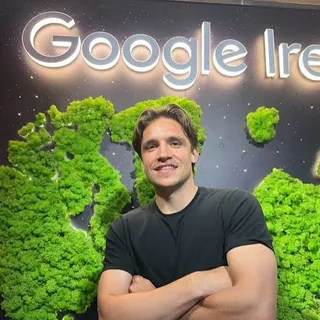
From chat to execution: what changes in the agentic era?
Zuza Politowicz works in go-to-market and AI at Google Cloud, helping companies adopt and scale Google's AI products. Her starting point: AI has already changed how we search (as Kamil Tavas showed), how we create, how we write and how we learn. "AI is the water we swim in. The question is: how do we swim faster?" Her answer is agents.
Until now most of us have used AI in chat mode — ask a question, get an answer: "What is the latest performance data for our summer campaign?" The next steps are think and reason — "compare the click-through rates of our Q1 and Q2 email campaigns" — and execute: "identify our highest-value segment and draft personalised campaigns to maximise their lifetime value." The era of passive AI is over; agentic transformation has arrived.
Free access
Get the full article (and the other five talks)
Free, straight to your screen. One short form unlocks every article on this device — and we email you a link for anywhere else.
Which two kinds of agents matter for leisure companies?
| Type | Purpose | Examples |
|---|---|---|
| Internal productivity | Make employees more efficient by putting all company data to work | Action items from meeting notes, automated reporting, weekly follow-up emails, campaign copy |
| Customer experience (CX) | Make the guest journey easier, more personal and more immersive | Personal concierge, inspiration-to-booking conversations, multilingual support |
How do you use agents internally?
The tool Politowicz introduced is Gemini Enterprise. Most companies already use Google Workspace — Gmail, Drive, Calendar — but also a CRM with client data, a ticketing system, accounting software and more, each used separately. Gemini Enterprise unifies the context across all of those systems in a single, secure location, built on a trusted platform with enterprise-grade compliance, security and sovereignty controls, so IT does not have to worry.
In practice: you connect the data sources you want to use, then ask — "based on the past meeting notes, what are the pending action items for this project?" You can build your own agents and workflows ("if this topic comes up in the team meeting, send that person an update email every Tuesday") or download ready-made agents from the marketplace. Asked whether non-Google systems can be connected — a park's own cash-register system, say — the answer was yes: plug in your CRM, your accounting system, as much as you can.
What have travel and leisure companies achieved?
Virgin Voyages wanted to amplify a strong brand across all its customers. With Gemini Enterprise as "the front door for AI in our business" it launched 50+ specialised agents, including "Email Ellie" for marketing and Project Ruby, a concierge that helps crew answer any question and helps sailors get more out of their trip — from inspiration at home to the last day on board, even offline at sea thanks to Google Distributed Cloud Edge. Results reported: production timelines cut by up to 60%, around 40% less time on campaign copy, and a 28% year-on-year increase in July sales driven by AI-generated campaigns, contributing to a record sales quarter.
Karls Erlebnis-Dorf, the German family-park group, was scaling fast with data siloed across systems, from marketing to regulatory. With Gemini Enterprise it brought that data together, rolled out to 80 users and replaced spreadsheets with automated data analysis — saving roughly 160 hours a week and letting the team focus on guest experiences.
On the customer-experience side, HBX Group (travel distribution) now handles more than 30% of repetitive cases such as fee waivers autonomously, has automated 18% of high-volume phone interactions with an intelligent voice channel, and offers 24/7 local-language support through real-time two-way translation. RIU Hotels & Resorts uses Google Cloud machine-learning models to predict purchase probability for its e-commerce team, and trivago uses Vertex AI to show more personalised options based on what a user has done before.
How is agentic AI changing the traveller's journey?
Nearly half of executives (47%) say they will put more than half of their future AI budget into agents (Google Cloud, The ROI of AI, October 2025). For travellers the shift is already visible: inspiration from a video, then flights from LA to Rome, upgrade options, a hotel, things to do in the city — all in one conversation, with actions done on your behalf. In the Virgin Voyages example the system remembered a guest's anniversary request and brought it back in later interactions.
The new benchmark for consumer experiences: personalised results, actions done on your behalf, immersive experiences. Find exactly what's needed, fix things fast the first time, engage in the guest's preferred channel and language.
What do the leading travel companies have in common?
Google Cloud works with hotel groups, airlines, cruise lines, OTAs and attractions. What they share, in Politowicz's words, is that they make the most of their data. Collecting it is not the hard part — connecting it and letting agents act on it is. Start with one internal use case, connect as many sources as you can, and build from there.
Questions the room asked
What is Gemini Enterprise?
Google Cloud's enterprise AI platform (formerly Agentspace) that unifies the context of all your systems — Google Workspace, your CRM, ticketing, accounting and other apps — in one secure environment, and lets you run ready-made or self-built agents across that data.
Can it connect to non-Google systems, like our ticketing or cash-register system?
Yes. Data sources can be plugged in, including your CRM, accounting and other operational systems. The more sources you connect, the more useful the agents become.
Where should a park or museum start with agents?
Internally, with a productivity use case where data is siloed today — for example turning meeting notes into action items, or replacing manual spreadsheet reporting with automated analysis, as Karls Erlebnis-Dorf did. Then extend to guest-facing personalisation.

About the speaker
Zuza Politowicz works in go-to-market and AI at Google Cloud, where she helps companies adopt Google Cloud and AI products and scale them.
Want to talk about this for your park, museum or destination?
Red Online Marketing works with attractions, zoos, museums, holiday parks and destinations across Europe on exactly these questions. Read more: email marketing & CRM at Red. Or email events@redonlinemarketing.com / get in touch via redonlinemarketing.com.